Posted on 21 Oct 2025 • Modifications
Transverse-Twin Scooter Swap: A Complete Bolt-On & Fabrication Guide
Author
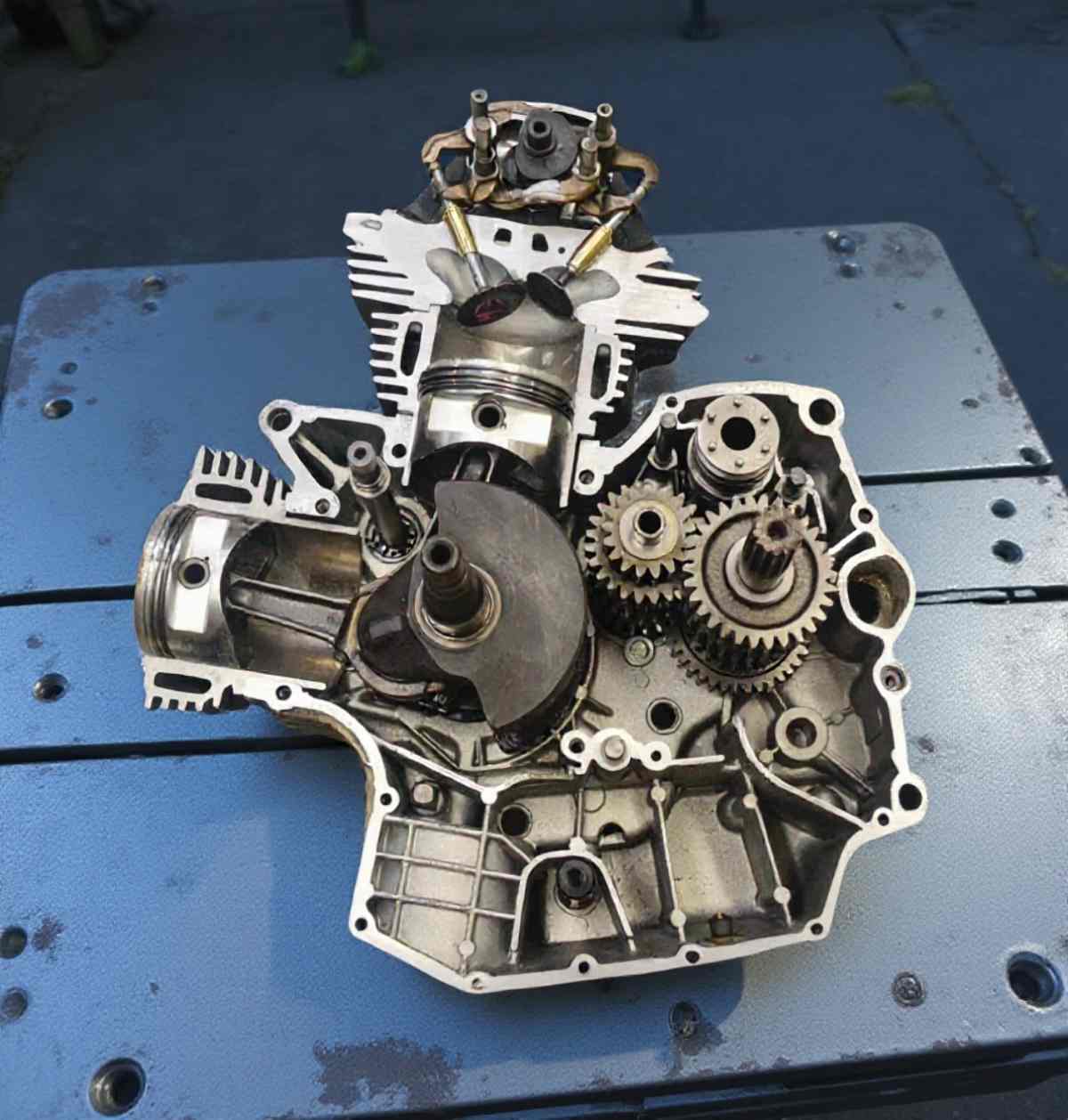
How to Swap a Transverse-Twin Into a 1960s Scooter Frame – the Complete Bolt-On & Fabrication Tutorial
Reading time: 6 min | Word count: ≈ 1,050
Skill level: intermediate (welding, lathe work) | Tools: MIG/TIG, lathe, laser-level, torque-wrench, frame-jig
Table of Contents
- Why a Transverse-Twin? – Torque, Vibes, Cool Factor
- Which Donor Engines Fit Without Frame Surgery? – Width Chart
- Real-World Case Study – Lambretta Li 150 → Moto-Guzzi V50 (Step-by-Step)
- Mounting Geometry – Keep the Chain-Line Straight & the Vibes Low
- Cooling & Intake – Let Both Jugs Breathe
- Balance & Crank Choice – 270° vs 360° vs 180° Explained
- Chain vs Shaft – What Actually Bolts In?
- Paperwork & Legality – V5, Noise, Insurance
- 60-Second Buyer / Builder Checklist – Numbers, Angles, Angles Again
- Quick-Fire FAQ – Jetting, Vibes, Cost, MOT
1. Why a Transverse-Twin? – Torque, Vibes, Cool Factor
Swapping a transverse-twin engine into a classic scooter isn't just about power; it's about character. You're trading the buzzy single for a torquey, balanced, and visually stunning powerplant that defines café-scooter cool.
| Gain |
How Much? |
Vintage Single Baseline |
| Torque |
+40-60 % |
150 cc = 9 Nm → 500 cc twin = 14 Nm |
| Primary balance |
90 % (270° crank) |
mirror stays clear @ 90 km/h |
| Cooling |
both cylinders in airflow |
-20 °C head temp vs longitudinal |
| Packaging |
< 450 mm width |
knees still fit inside leg-shield |
| Looks |
“jugs-out” classic stance |
instant Moto-Guzzi vibe |
2. Which Donor Engines Fit Without Frame Surgery? – Width Chart
The key to a bolt-in feel is engine width. You need to clear the scooter's leg-shields without major surgery. Here are the top contenders.
| Donor |
cc |
Width (max) |
Drive |
Notes |
| Moto-Guzzi V50 |
490 |
410 mm |
shaft |
air-cooled, single carb, 34 hp |
| Honda CX500 |
497 |
420 mm |
shaft |
water-cooled, 5-speed, 48 hp |
| Yamaha TRX850 |
849 |
440 mm |
chain |
270° crank, 79 hp, big-block look |
| Suzuki SV650 |
645 |
435 mm |
chain |
64 hp, cheap spares, 6-speed |
Rule: < 450 mm overall = clears Vespa PX leg-shield; > 450 mm = cut leg-shield or accept exposed cylinders.
3. Real-World Case Study – Lambretta Li 150 → Moto-Guzzi V50 (Step-by-Step)
Finished weight: 108 kg (+6 kg) – but 34 hp vs 7 hp = 5× power-to-weight.
Step 1 – Strip & Measure
Remove engine, panels, tank, wiring. Laser-level through swing-arm pivot → mark centre-line on floor. Measure V50 width: 408 mm → decision: no leg-shield cut.
Step 2 – Fabricate Cradle
5 mm plate boxing-frame welded under original spine tube. M8 rubber-cone mounts copied from Guzzi frame – vibration isolation. Engine inclination: 5° forward (factory angle).
Step 3 – Primary Drive
Cut Lambretta clutch centre, machine 19 mm internal spline. Weld to Guzzi input shaft – straight-through chain (14-42 sprockets). Chain-case: copy original Lambretta shape, 3 mm ally, quick-release like GP bike.
Step 4 – Cooling & Electrics
NACA duct in left leg-shield → feeds 80 mm 12 V fan → blows across cylinder fins. M-Unit Blue under glove-box, Bluetooth map-switch, 12 V lithium battery under floor.
Step 5 – Finish & Test
Kick-start retained (Guzzi lever). Dyno: 34 hp @ 6,800 rpm, torque 38 Nm @ 5,200 rpm. Top speed: 135 km/h (84 mph), 0-100 km/h in 9.2 s.
4. Mounting Geometry – Keep the Chain-Line Straight & the Vibes Low
Precision here separates a smooth, reliable runner from a vibrating, chain-throwing nightmare.
| Dimension |
Target |
How to Measure |
| Crank centre-line vs rear axle |
< 1 mm offset |
laser pointer through sprockets |
| Crank height above ground |
200-220 mm |
digital angle gauge on sump |
| Engine inclination |
5° forward |
phone inclinometer on rocker cover |
| Rubber mount deflection |
< 2 mm at 4,000 rpm |
feeler gauge under mount cone |
Weld axle plates last – after engine is rubber-mounted and aligned.
5. Cooling & Intake – Let Both Jugs Breathe
Air-cooled: NACA duct + 80 mm fan, thermo-switch @ 100 °C.
Water-cooled: radiator up front (headset area), 12 V pump, thermostat 82 °C.
Carb placement: single 34 mm Mikuni between cylinders → uses original glove-box cavity, filter pokes through badge hole.
6. Balance & Crank Choice – 270° vs 360° vs 180° Explained
The crank's firing order defines the engine's soul—its sound and vibration.
| Angle |
Firing Sound |
Vibe Level |
Best Use |
| 360° |
Thumper-plus |
High |
Retro sound, simple crank |
| 270° |
V-twin burble |
Med-Low |
Road bikes, café-scoots |
| 180° |
Even firing |
Lowest |
High-rpm track |
Most CX-based swaps stay 180° – smoothest, but 270° gives the “bop-bop” soundtrack people expect.
7. Chain vs Shaft – What Actually Bolts In?
This fundamental choice affects maintenance, weight, and final drive options.
| Drive |
Pros |
Cons |
| Chain |
Lighter, easy gearing, cheap |
Needs guard, lube mess, stretch |
| Shaft (Guzzi) |
Zero maintenance, clean, looks OEM |
4 kg heavier, wider overall, fixed ratio |
Rule: >5,000 km/year = shaft wins; like sprocket experiments = chain is king.
8. Paperwork & Legality (UK Example)
DVLA engine change notification – new cc on V5, insurance informed – premium rise ≈ £40/year. MOT: no emissions test for pre-1960, but noise < 99 dB – fit 2-stage silencer. Frame VIN retained – do NOT grind off spine number; weld new plates alongside.
9. 60-Second Buyer / Builder Checklist
- ✅ Engine width < 450 mm – clears knees
- ✅ Chain/shaft centre-line within 1 mm of rear sprocket – laser-check
- ✅ Rubber-mount engine, 5° forward tilt – vibe control
- ✅ Jet up 2 sizes, retard ignition 1° – piston insurance
- ✅ Notify DVLA / insurer, keep old drum brake for MOT – paperwork peace
10. Quick-Fire FAQ
Q1. Will a 12 mm axle take a modern 15 mm disc hub?
No – sleeve-spacer (£20) or swap axle (£60).
Q2. Do I need to balance the crank?
Not if you use factory 180° or 270° – they’re already balanced; 360° benefits from 10 % over-weight on flywheel.
Q3. Is the swap reversible?
Yes – don’t cut the spine tube; weld plates alongside so original engine can bolt back in.
Q4. How much does it cost?
£2,100 parts + 49 hrs labour – compare to £450 big-bore kit but you get twin character and double torque.
Q5. Will it pass emissions?
Pre-1960 exempt in UK; post-1960 needs lambda sensor + cat if you want Euro 4 compliance – most owners stay historic exemption.
Bottom Line
Swapping a transverse-twin into a 1960s scooter is bolt-and-weld Lego for anyone with a lathe and a long weekend. You gain V-twin charisma, shaft-drive reliability and double the torque while keeping the classic “jugs-out” silhouette that turns petrol-station chats into 20-minute history lessons. Plan the chain-line, brace the spine, jet it fat – then let the twin thump echo off 1950s steel like Milan never went out of style.

 User Torque Posts by this author Posts by this author