
Posted on 13 Aug 2026 • Modifications
YZ490/IT490 Head Modification: The Squish Band Edge Cut
Author
 User Torque Posts by this author Posts by this author
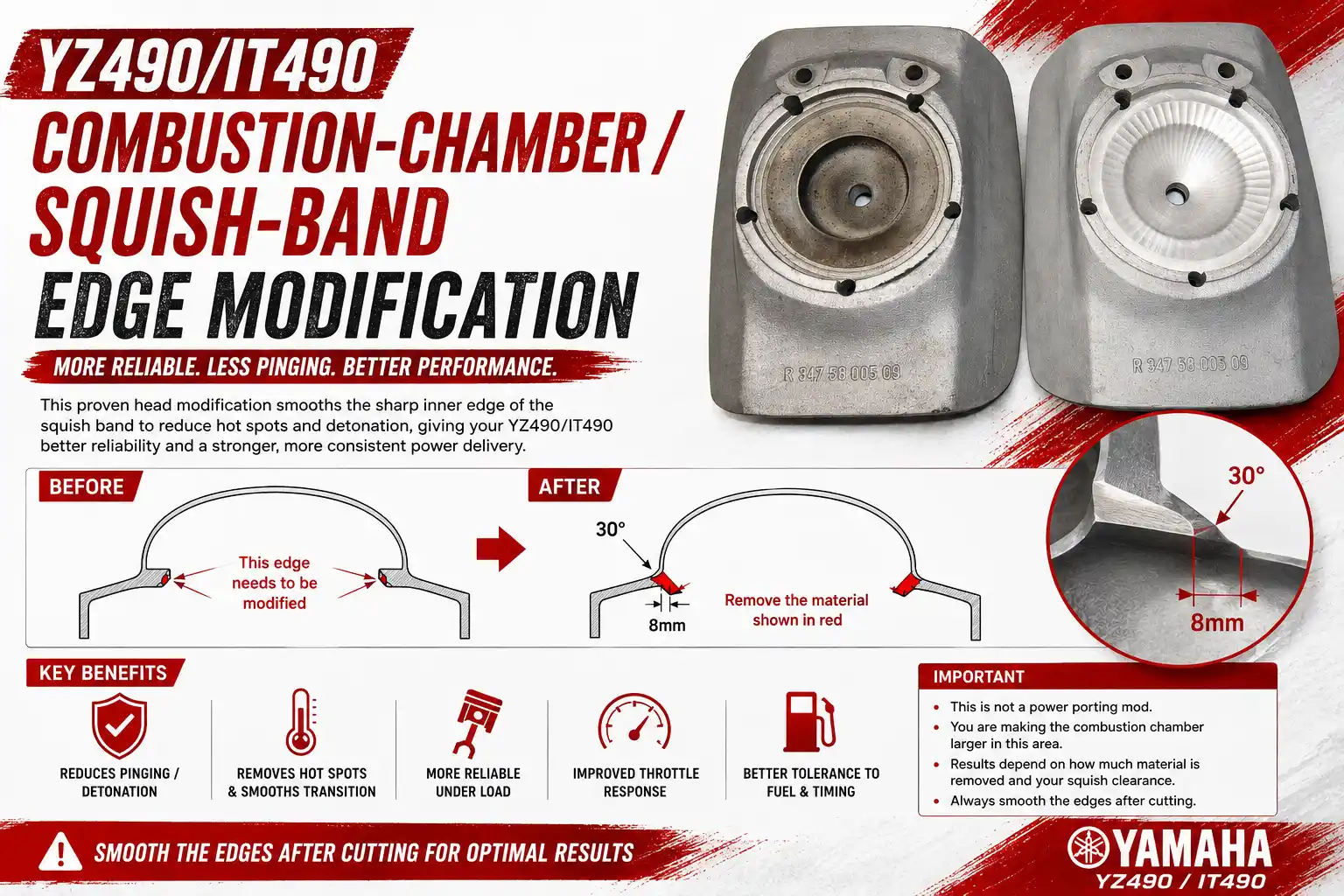
The Squish Band Edge Cut That Actually Solves Detonation
What Every Serious 490 Owner Needs to Know Before Touching That Head
If you've spent any real time on a Yamaha IT490 or YZ490, you already know the reputation. These machines are absolute animals — raw, powerful, and completely unforgiving when they decide to ping. And if you've been digging through old build threads or talking to guys who actually raced these bikes in the early '80s, you've probably come across a very specific head modification involving a 30-degree chamfer cut at the squish band's inner edge.
This article breaks down exactly what that modification is, why it works, what it changes inside the combustion chamber, and — most importantly — why you shouldn't just grab a cutting tool and go to work without measuring first.
What Modification Are We Actually Talking About?
The modification in question is commonly called the YZ490/IT490 combustion chamber squish band edge modification.
In practical terms, it's an angled cut — approximately 30 degrees, about 8 mm wide — machined at the inner edge where the squish band transitions into the combustion chamber. Instead of a sharp, abrupt corner sitting at that transition point, you end up with a smooth, chamfered edge that eases the geometry from the flat squish zone into the domed combustion chamber.
This wasn't some backyard hack invented by one creative owner. Period-correct YZ490 discussions from riders who actually campaigned these bikes specifically describe this cut as a head modification designed to combat the engine's well-documented tendency to ping and detonate under load.
Why the YZ490 and IT490 Had a Detonation Problem to Begin With
To understand why this modification matters, you need to understand why the 490 was particularly vulnerable to pinging in the first place.
The big Yamaha 490 — both the closed-course YZ and the enduro-spec IT — earned a genuine reputation for detonation sensitivity. Not just occasional light pinging under marginal conditions. We're talking about chronic pinging under heavy throttle load, especially when the engine was hot.
Several factors combined to create this problem:
Air Cooling
Unlike the liquid-cooled machines that eventually replaced it, the 490 relied entirely on air to manage cylinder and head temperatures. On tight, technical sections where airflow dropped and throttle demand stayed high, heat buildup became serious very quickly.
High Compression for the Era
These engines ran aggressive compression ratios to generate their considerable power output. High compression means higher combustion pressures and temperatures — exactly the conditions that encourage detonation.
The Squish Band Geometry
The stock head featured a relatively abrupt transition where the squish band met the combustion chamber. That sharp inner corner, under extreme heat and pressure, could become a hot spot — a localized area that stayed hot enough between combustion events to initiate ignition before the spark plug fired intentionally.
The Consequence
Detonation doesn't just feel rough and sound terrible. In a high-performance two-stroke running hard in the dirt, detonation causes seizure. Owners who ignored the pinging often didn't get a second warning before the engine locked up.
What the 30-Degree Cut Actually Does
Here's where a lot of people get confused, because this modification often gets lumped in with "porting work" or "power modifications." It isn't.
The primary benefit of the squish band edge modification is detonation resistance, not outright power.
Let's go through exactly what removing that material accomplishes:
It Smooths the Transition Zone
The sharp corner between the squish band and the combustion chamber is replaced by a gradual, angled surface. The end-gas that gets pushed inward by squish action no longer slams into an abrupt wall. The flow is cleaner, the turbulence more controlled.
It Eliminates a Potential Hot Spot
Sharp edges and corners in combustion chambers retain heat disproportionately. A corner that stays too hot becomes a glow plug — it ignites the charge before the spark does. Removing that sharp edge removes that heat retention point.
It Makes the Combustion Environment Less Detonation-Prone
Detonation happens when the end-gas ahead of the flame front auto-ignites due to heat and pressure. A smoother, better-controlled combustion chamber geometry gives that end-gas a slightly better environment. Not dramatically different — but enough to move the engine away from the detonation threshold.
It Widens the Safety Margin
This is the practical real-world benefit. After the modification, riders report that the engine tolerates the conditions that previously caused pinging — hot weather, a slightly lean jetting situation, heavy load on a long climb — without immediately crossing into destructive detonation.
It Cleans Up Throttle Response Under Load
Several owners note that after the head work, throttle response feels more consistent and linear, particularly when the engine is working hard. This likely reflects a more stable, controlled combustion process rather than one flirting with the detonation boundary.
It Gives Breathing Room for Fuel and Ignition Variation
Real riding conditions aren't dyno conditions. Fuel quality varies. Jetting changes with altitude and temperature. Ignition timing on a worn points system drifts. A detonation-resistant combustion chamber tolerates that variation better.
The Critical Point That Gets Overlooked
Here's what every article and forum post on this subject needs to say clearly, and often doesn't:
The 30-degree, 8 mm cut makes the combustion chamber larger in that region.
This is not a trivial point. When you remove material from the inside of a combustion chamber, you are directly affecting:
- Combustion chamber volume
- Compression ratio
- Squish band geometry and squish velocity
- Overall combustion characteristics
How much those parameters change depends entirely on how much material is removed — and that varies based on the exact geometry of the specific head on the specific engine you're working with.
This is why simply copying the 30-degree angle and the 8 mm dimension from a spec sheet or a forum post is not enough for optimization. It might get you close. It might get you into trouble. The only way to know is to measure.
Why Measuring Before Cutting Is Non-Negotiable
If your goal is a strong, reliable IT490 or YZ490 that you can actually trust when it's working hard, approach this the right way.
Before any material comes off that head, measure:
Current Combustion Chamber Volume
Use the burette and light oil method. Know your baseline. Every cubic centimeter of chamber volume removed by the chamfer cut reduces compression ratio — you need to know by how much.
Actual Squish Clearance
Squish clearance — the gap between the piston crown and the squish band at top dead center — has an enormous influence on how the squish zone actually functions. Too tight and you risk mechanical contact. Too loose and the squish effect weakens significantly, reducing both power and detonation resistance. Measure with solder or modeling clay at TDC.
Squish Band Width
The flat portion of the squish band has an optimal width range. Too narrow and it doesn't push end-gas effectively. Too wide and you're losing combustion chamber efficiency. Know what you're starting with.
Piston-to-Head Relationship at TDC
Related to squish clearance but worth checking independently, particularly if the engine has been apart before or the head has been skimmed at some point.
Ignition Timing
The YZ490 and IT490 are sensitive to ignition timing. Advancing timing on an engine that already pings makes things dramatically worse. Verify timing is correct before assuming head work alone solves the problem.
Current Jetting
A lean carburetor raises combustion temperatures and pushes the engine toward detonation. Head modification doesn't compensate for wrong jetting. Know where your needle clip, main jet, and needle position sit.
Fuel Octane Being Used
If you're running pump fuel in a high-compression 490, octane matters. Knowing your current fuel spec tells you how much detonation margin you're actually working with.
Once you have those numbers, you can calculate with reasonable precision what the 30-degree × 8 mm modification will do to your compression ratio and chamber volume — and whether you need to adjust the squish clearance or ignition timing to complement the head work.
Real-World Experience From the People Who Actually Ran These Bikes
The value of period-correct owner experience on the 490 can't be overstated. These were bikes being campaigned hard in real competition, often in remote locations where a seizure meant a very long walk.
The consistent picture that emerges from experienced 490 owners:
- The squish band chamfer modification genuinely improved detonation resistance
- The modification works best as part of a broader setup review — compression, squish clearance, timing, and jetting all addressed together
- Owners who did only the head cut without reviewing the rest of the setup sometimes saw limited improvement
- The engines that came out reliably strong were the ones where someone actually measured everything before and after
One specific account describes the modification as an 8 mm wide, 30-degree chamfer at the inner radius of the squish band, with the work done as part of a broader effort to make the engine more detonation-resistant rather than as a standalone "more power" modification.
That framing is exactly right.
How This Fits Into a Complete IT490/YZ490 Setup
For anyone building or refreshing a 490 with genuine reliability as the goal — not just maximum dyno numbers — consider the squish band modification as one component of a complete detonation-resistance strategy:
| Factor | What to Check | Why It Matters |
|---|---|---|
| Combustion chamber volume | Measure before and after | Controls compression ratio |
| Squish clearance | .035"–.060" typical target range | Affects squish velocity and detonation tendency |
| Squish band width | Measure existing geometry | Determines how much chamfer changes things |
| Ignition timing | Verify against spec | Wrong timing multiplies detonation risk |
| Jetting | Full carburetor review | Lean conditions cause heat spikes |
| Fuel | Minimum 91 octane recommended | Sets your baseline detonation margin |
| Cooling fins | Clean, unobstructed | Critical for air-cooled engine health |
Final Word: Respect the Process

The YZ490 and IT490 are genuinely great machines with a character that modern motocross bikes simply don't have. The 30-degree squish band edge modification is a legitimate, period-proven solution to a real problem that these engines had from the factory.
But it works because of what it does to combustion geometry — and that means it interacts with every other parameter in the engine. Do it right, measure everything, and you end up with a 490 that runs hard, runs honest, and doesn't send you home early with a seized piston.
Do it without measuring, and you've made changes you can't fully account for.
The bike deserves better than guesswork. So does the riding you're planning to do on it.
Have questions about your specific IT490 or YZ490 head geometry? Drop your current chamber volume and squish clearance measurements in the comments — happy to help work through the numbers.