The Yamaha RD350: India's Most Loved Two-Stroke, Kept Alive

A 347cc air-cooled twin that embarrassed bigger bikes in the 1970s — and still does. This site is a working reference for anyone who owns, restores, or simply can't stop thinking about the RD350.

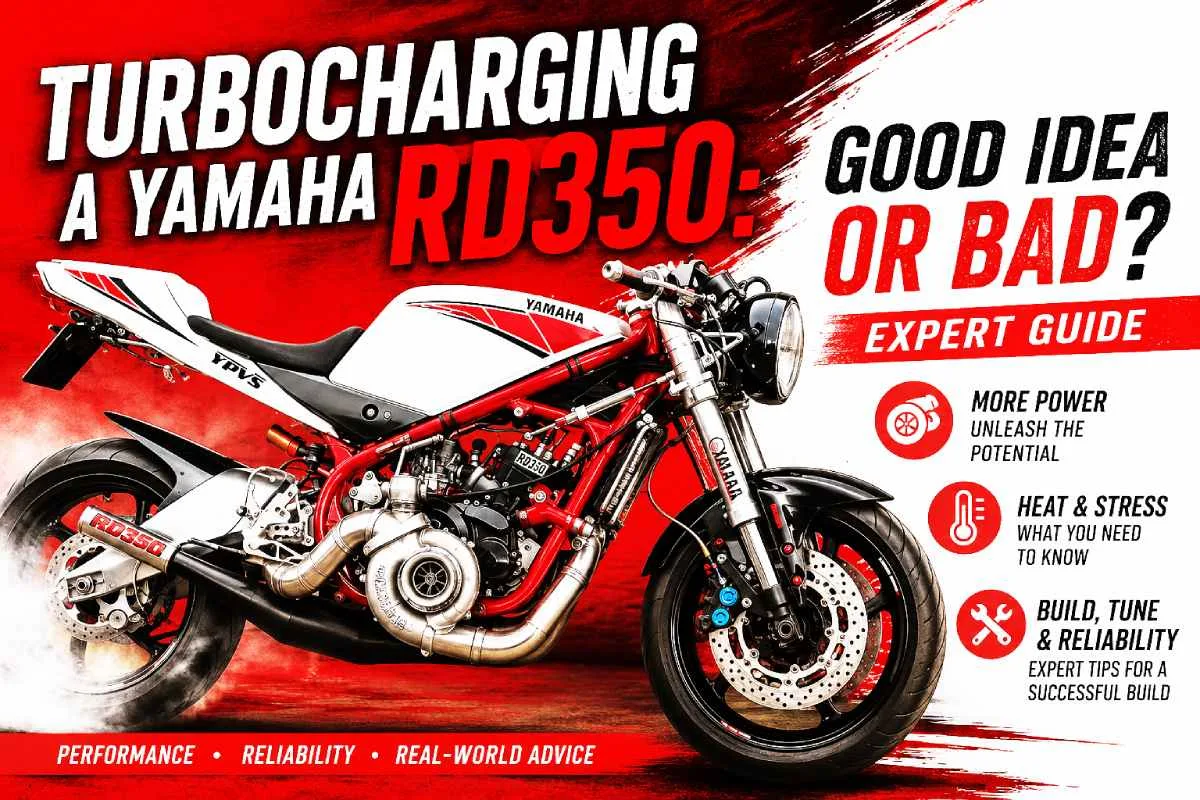
Yamaha RD350 air-cooled two-stroke parallel twin — the classic 347cc motorcycle produced from 1973 to 1975

Test Your Motorcycle Knowledge

Loading question...
347ccDisplacement
39 bhpPeak power (US spec)
7,500 rpmPower peak
6-speedGearbox
152 kgWet weight
1973–79Production years

What's on this site

Most RD350 information online is scattered across forum threads from 2007 with half the images broken. This site pulls it together in one place — the history, the specs, the port maps, the tuning methods, and tools you can actually use in the garage.

History
From the YA1 to the RD

How Yamaha went from copying a German DKW in 1955 to building one of the most revered two-stroke twins ever made.

Full article
Specifications
RD350B spec sheet + port maps

Original spec sheet for the RD350B plus port maps for the Indian HT and LT variants from Erlenbach Racing.

Technical reference
Maintenance
Keeping the engine alive

Daily and monthly maintenance routines specific to the RD — oil checks, brake care, carb cleaning, and break-in procedures.

How-to
Performance
More power without splitting the cases

Carburetor mods, needle jets, air filter swaps, and the full Dale Alexander tuning guide for the RD350 and RD400.

Tuning guide
Tool
Two-stroke exhaust designer

Calculate expansion chamber dimensions for any two-stroke engine online. No spreadsheet needed — enter your port timings and get cone dimensions out.

Free tool
Ignition
Ignition timing guide

Setting points gap, static timing, and dynamic timing on the CB points system. Includes BTDC specs for both HT and LT Indian variants.

Technical guide

There are also guides on squish band tuning, carburetor jetting, expansion chamber selection, aftermarket ignition systems, and a cone designer tool for building custom exhaust cones. Downloadable service manuals are available at shop.rd350.info.

What made the RD350 different

When the RD350 arrived in 1973, 350cc was a competitive displacement class. The Kawasaki S2 triple was quicker in a straight line but needed a brave rider. The Honda CB350 four-stroke was smoother but slower. The RD350 sat between them with a trick nobody expected at that price: a frame lifted directly from Yamaha's TZ250 and TZ350 racing bikes, with a 27-degree fork rake that made it handle like nothing else in the class.

The engine was already well-developed from the DS7 and R5 lineage. Adding reed valves to the intake widened the power band and made the bike much more rideable in real traffic compared to the earlier piston-port designs. The Autolube automatic oil injection system — which pre-mixed two-stroke oil at the carburettor inlet so you didn't have to pre-mix your fuel — was a practical feature that four-stroke riders had quietly laughed at, until they tried to match the RD's pace.

It weighed 152 kg wet. It made 39 bhp in US specification. That power-to-weight ratio, combined with the racing-derived geometry, is why road tests from 1973 kept turning up the same observation: the RD350 could keep up with bikes twice its size on anything other than a dead-straight road.

The frame detail most people miss: The RD350's chassis was not adapted from a racing design — it was the racing design. The geometry is essentially identical to the Yamaha TZ250 and TZ350 that were winning races in period. Yamaha put it in a road bike for under $1,000.

The two-stroke engine — what it actually means to own one

A two-stroke engine fires once every revolution of the crankshaft, compared to a four-stroke's once every two. That's why a 350cc two-stroke twin feels closer to a 600cc four-stroke in terms of power delivery — more combustion events per minute means more usable energy from less displacement.

The trade-off is that lubrication works differently. There's no separate oil sump. Two-stroke oil is either pre-mixed into the petrol or injected automatically at the carburettor inlet (as on the RD350's Autolube system). This oil burns with the fuel and lubricates the engine on its way through. RD400 models reverted to manual premixing. The Indian Rajdoot variants — both HT and LT — also require premixing.

What this means practically: you don't do "oil changes" on a two-stroke the way you do on a car. You monitor the separate oil tank (or premix ratio), keep the carburettors clean, watch the reeds, and check plug colour after any tuning change. The maintenance is different, not harder.

The RD350 rewards riders who understand this. It punishes those who ignore it. A well-maintained engine with correct jetting and fresh reeds is genuinely quick. A neglected one with a clogged air jet and tired reeds is a frustrating machine that never hits the powerband cleanly. The difference between those two bikes is information — which is what this site is for.

The Indian Rajdoot 350 — same DNA, different story

For Indian riders, the RD350 arrived not as a Yamaha but as a Rajdoot, built by Escorts Group in Faridabad under a Yamaha licence from 1983 to 1990. It was based on the RD350B architecture but detuned for Indian fuel quality and economy concerns.

Two versions were produced. The High Torque (HT) made 30.5 bhp and could reach 160 km/h — faster than anything else on Indian roads in the mid-1980s. The Low Torque (LT), introduced in 1985 at 27 bhp, was an attempt to improve fuel consumption, which was the Rajdoot's main commercial weakness.

Neither variant sold in large numbers. The price was steep, the mileage was unimpressive next to the Hero Honda CD100, and by 1987 the commuter bike segment had moved on. Production ended in 1990. Cycle World USA ranked it among the top 10 motorcycles of the century regardless.

Today, a good Rajdoot 350 HT is worth hunting. The port maps, specs, and tuning information for both variants are documented on the specifications page, including timing figures (2.0 mm BTDC for HT, 2.4 mm BTDC for LT) that are hard to find anywhere else.

Read the full RD350 and Rajdoot history →

Common questions

What is the difference between the RD350 HT and LT?

HT (High Torque) and LT (Low Torque) refer to the two Indian Rajdoot 350 variants made by Escorts. The HT produces 30.5 bhp and has more aggressive port timing; the LT produces 27 bhp with milder timing for better fuel economy. The port maps for both are documented on the specifications page.

Can the RD350 run on modern petrol?

Yes, with some attention to jetting. Modern pump fuel typically has higher octane than what the RD350 was originally tuned for, which can affect carburetor jetting and ignition timing. The carburetor tuning guide and ignition timing page cover the adjustments needed.

What two-stroke oil should I use in an RD350?

For Autolube-equipped RD350s (US market), use a quality JASO FC or FD rated two-stroke oil in the separate oil tank — do not mix it with the fuel. For RD400s and Rajdoot variants that require premixing, the recommended ratio is typically 20:1 during break-in and 30:1 when fully run in, though this varies with the specific oil grade.

Is there an online tool to design a two-stroke expansion chamber?

Yes — this site has one. The Exhaust Designer tool calculates expansion chamber dimensions from your engine's port timing data. There's also a separate Cone Designer for individual cone sections.

Where can I download the RD350 service manual?

PDF service manuals for the RD350, RD400, Indian Rajdoot variants, and several other two-stroke engines are available at shop.rd350.info.

RahilJK — TorqueInductions
RahilJK (TorqueInductions) RD350 owner, restorer, and two-stroke mechanic based in India. This site is maintained from personal workshop experience with the Jawa 250, Yamaha RD350, and RX100. About this site →

Download Manuals

Download several useful manual files in PDF format for many two-stroke engines/models.

Donate Us

Consider buying me a coffee if you enjoy the content shared with you.